

And they called it Guppy … Love?
Hi Everyone, it’s me!
Welcome to the first Cardio and Conservation blog post focusing on my personal PhD research!
This has been a long time coming! Until now I felt like I didn’t actually know … anything, and had little to contribute to C&C.
But I can finally sit down and update you on the current plan for my first thesis chapter on guppy mate choice.
Sounds dull you may think, but WAIT! Please don’t go.
Guppies
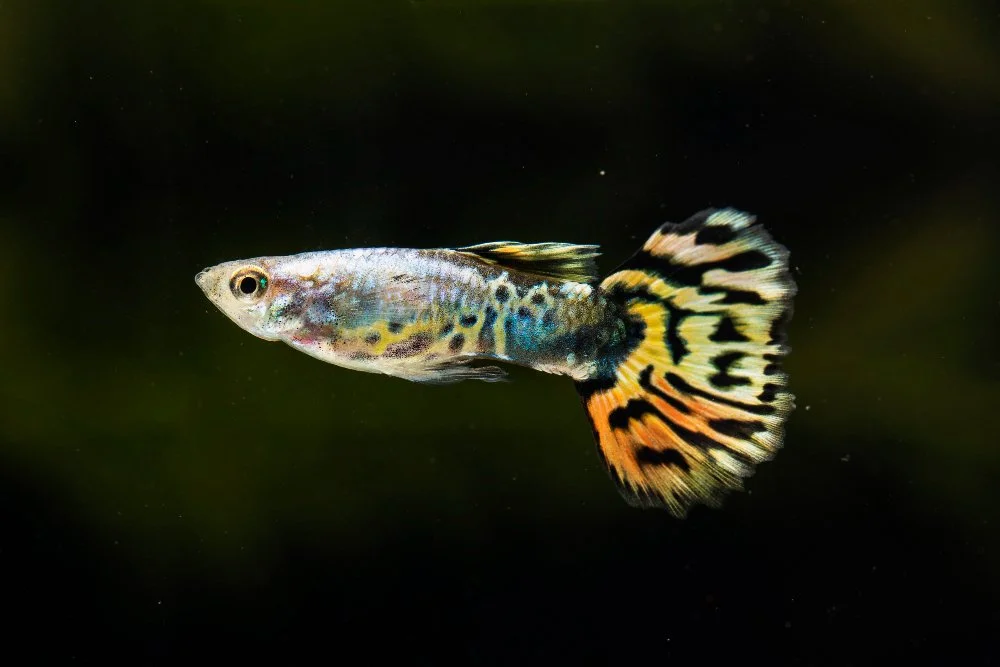
You may be used to seeing guppies in home aquariums – with their beautiful, colourful, flowy tails (right), though they look a little different in the wild. Guppies (Poecilia reticulata) are small freshwater fish native to parts of South and Central America, and the Caribbean, including the island of Trinidad – where my research will be based.
And whilst these small, unassuming little fish might not seem interesting at first, they have been a model species for biological and ecological research for many decades for a variety of reasons, including sexual and natural selection. They’re actually pretty cool little fish!
First, a little bit of background.
[Source https://www.freepik.com/]
Live bearers
Guppies belong to a Family of freshwater fish called Poeciliidae, which includes nearly 300 species, a few of which are common home aquarium species, such as mollies and platys. If you’ve kept any yourself, you’ll already be familiar with something very cool about these fish – females give birth to fully-formed live offspring. (Tiny little guppies = adorable!).
In all Poecilid species except one, female eggs are fertilized internally – inside the female’s body – and females give birth to live young (as opposed to laying eggs which are fertilized by males externally).
Within this Family of fish, varying methods of reproduction, maternal provisioning (motherly care) aspects of fish behaviour, and morphology (appearance) exist [1] as a result of strong sexual and natural selection (think Charles Darwin) acting on different species.
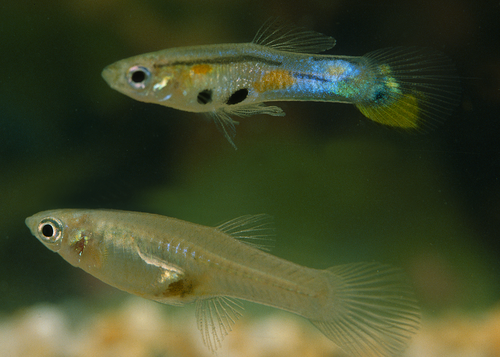
Trinidadian guppy (male, top, female bottom). [Source © Deacon et al, 2015]
For example, let’s take the placenta. We are likely all familiar with what the placenta is in humans, and other mammals. Placentas are extremely complex things. Within this Family’s phylogeny – picture a family tree of you and your ancestors – the placenta has evolved not once, not twice, but multiple times. This is pretty incredible.
As another example, ornamentation or specialised fins vary widely between species, with sword-tails having a, you guessed it, sword-like tail, whereas some mollies have large dorsal fins (the fin on the back).
These variations have made Poecilids the result of decades of scientific research to further our understanding of complex processes.
Moving back to guppies, females in the wild give birth to anywhere from 6 to 30 young – this can depend on many things including the size of the female and her habitat (if she is safer from predators it is likely she will produce fewer, larger young [2][3]). In domestic varieties (pet-shop guppies) broods may be larger, as these guppies are typically larger than their wild counterparts.
Female guppies are larger than males and less brightly coloured.
Sexual Selection
Guppies have been the focus of a lot of research because they are a classic example of something Charles Darwin described, Sexual Selection:
“the advantage which certain individuals have over other individuals of the same sex and species solely in respect of reproduction”
There is a distinct – but often unclear- difference between Sexual Selection and Natural Selection (“survival of the fittest”), and there are two main parts; mate choice and mate competition.
For the sake of space, I’m over-simplifying, but, the first, in simple terms, can come down to preferences – does an organism of one sex choose an individual of the opposite to mate with, based on certain features? Mate choice is where I will focus my initial research attention.
Guppy Love
So what happens when it comes to guppy love, aka mate choice?
[Source Unsplash.com]
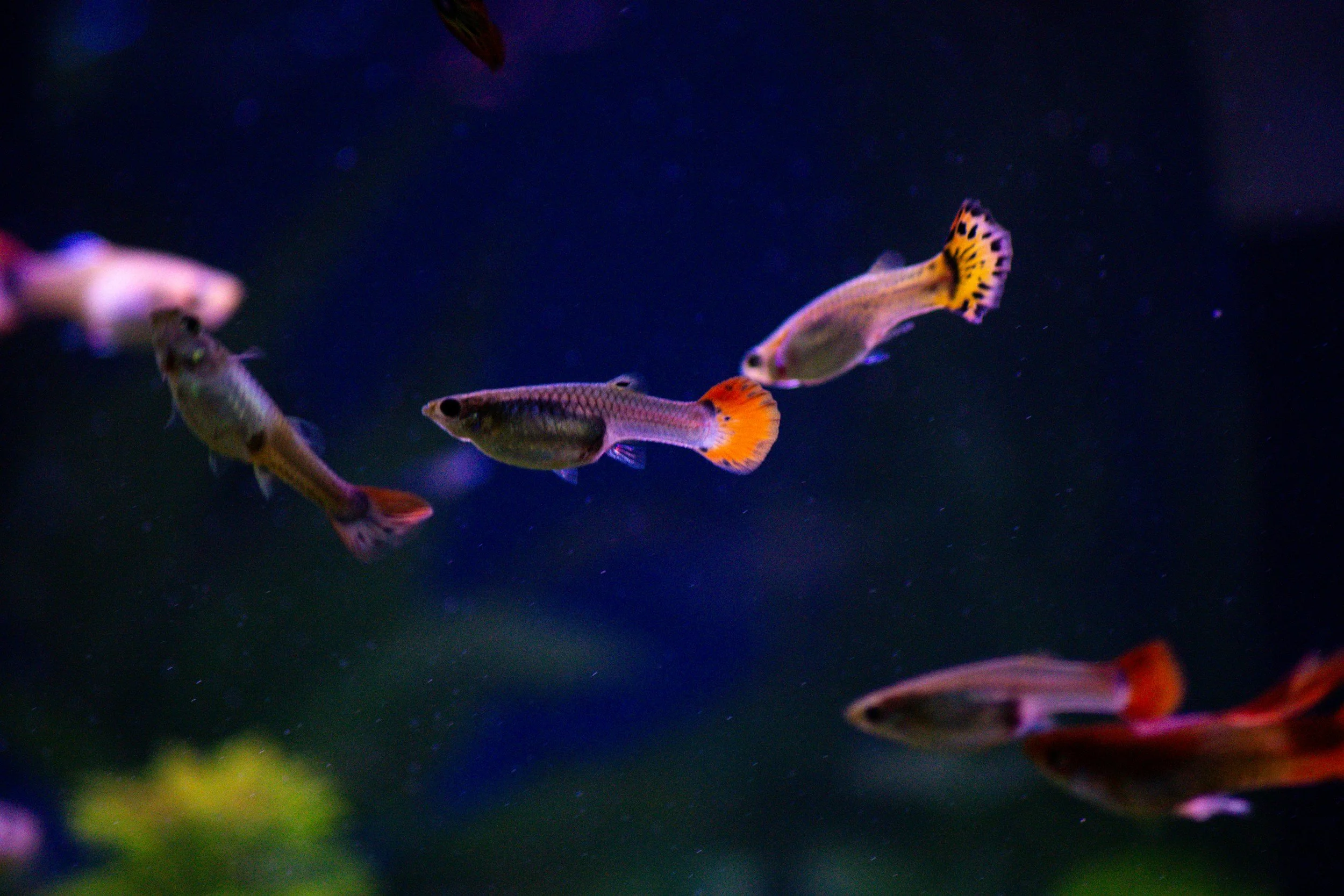
Females in general show a preference for more brightly coloured males. Male Trinidadian guppies display lovely bright patches of orange, black and iridescent blue/green. Colour patterns are genetic, but brightness can be affected by other factors including diet.
Bright orange guppies appear as ‘sexually superior’, healthy, high-quality mates, as this demonstrates their foraging ability to obtain pigments called carotenoids, which they cannot synthesise, through their food [5][6].
Therefore, it appears a preference for bright colours may confer good genes on offspring making males a worthy partner and beneficial mate.
This is female mate choice. Males also display preferences in their mates.
Male guppies typically prefer larger females as female size is linked to something called fecundity – the ability to produce offspring. (Remember earlier, larger females, more babies?).
But this is where things start to get interesting.
Male guppies, despite having a preference, will be largely concerned with passing on their genes. Female guppies must withstand near constant harassment from males, who will invoke one of two tactics to secure mating. Males may court and display to a female, and seek a mutual, consensual partnership (for us humans, this is good). Or males may engage in ‘sneaky mating’ and thrust themselves on a female without consent (in humans, this is very very bad. Never do this). Male guppies will switch which approach they take based on a few things, such as how interested the female is, and if they have an audience of competitors [2] [7] [8].
So why does female choice matter if they must tolerate potentially unsolicited insemination which would negate them choosing a male to mate with?
Well, still quite a lot.
I Choose You (Pikachu)
Female guppies can store sperm for a few months (even a year) which may fertilise the next brood during their next reproductive cycle.
But, I hear you. Why does this matter? If they’ve been inseminated by a male they did not choose, storing their sperm doesn’t make the most sense.
Studies have shown that female guppies exert choice at all stages of reproduction [2]*; They can choose who to mate with consensually based on their preferences. And they can mate multiply to potentially avoid the hassle of trying to outrun sneaky males. (There is some evidence that multiple mating increases the reproductive success of females [9]). But they do not have to use the sperm from these males.
I’m going to avoid going into how this happens, but in their study, Pilastro et al, (2004) [10] determined broods of females were predominantly fathered by a male they preferred, suggesting females have some control over fertilisation.
I personally find this fascinating.
Behavioural Ecologists
Guppies display such clear mate preferences, which is why sexual selection research on guppies is well subscribed in academic literature.
(Sexual selection for specific traits usually confers some advantage to the reproductive success and of offspring, however in one study on a fish from the family Goodeidae (I’m sorry, for the life of me I can’t find the paper at the moment) it was found that female preference for colourful males resulted in negative fitness for offspring. (We’ve all desired that person we know is no good for us…)
Of course, behavioural ecologists can state what we see, but this isn’t enough to fully explain everything.
For example, behavioural observations which expose a focal fish, let’s say a female, to two differently coloured male fish of similar size, or similarly coloured but different sizes, can establish a visual preference, but we cannot assess acoustic (hearing) or olfactory (smell) signals which are very likely to be involved in mate choice.
Chapter 1
I hope you’ve found this brief look at Sexual Selection in guppies interesting.
My first field season in Trinidad will focus on guppy mate choice from fish from multiple populations, specifically those that have been exposed to oil pollution, to see if this has caused any changes in their behaviour and therefore how they reproduce – see blog post here [coming soon].
If you have any questions on Guppy Love, any feedback or suggestions, please get in touch.
Until next time!

[Source Unsplash.com]
[1] Pollux et al., (2009). Annu. Rev. Ecol. Evol. Syst. DOI: 10.1146/annurev.ecolsys.110308.120209
[2] Magurran. E., (2005). ‘Evolutionary ecology..’. Oxford University Press ISBN: 978-0-19-852785-5
[3] Reznick and Endler., (1982). Evolution. DOI: 10.2307/2407978
[4] Hosken and House., (2011). Current Biology. DOI: 10.1016/j.cub.2010.11.053
[5] Grether, G., (2000). Evolution. 54(5)
[6] Grether et al., (2001). Proc. R. Soc. Lond. B. DOI: 10.1098/rspb.2001.1624
[7] Yoshikawa et al., (2016). Animal Behaviour. DOI: 10.1016/j.anbehav.2016.05.022
[8] Auld and Godin., (2016). Behav Ecol Sociobiol. DOI: 10.1007/s00265-015-1992-z
[9] Evans and Magurran., (2000). Proc. Natl. Acad. Sci. U.S.A. . DOI: 10.1073/pnas.180207297
[10] Pilastro et al., (2004). Evolution. DOI: 10.1111/j.0014-3820.2004.tb01690.x
