

‘I don’t belong here’ - Imposter Syndrome
Content warning – this blog deals with aspects of mental health and wellbeing
Hi everyone, it’s me!
And I, am an imposter!
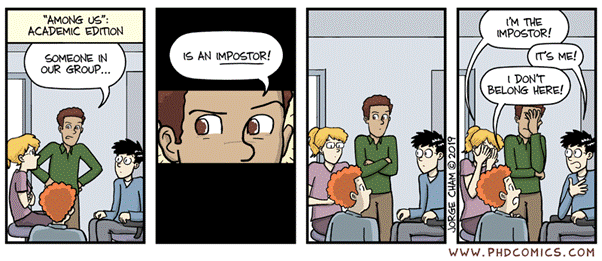
Image Copyright PhD Comics - I do not own this image
Let me ask you a quick question. Do any of these thoughts sound familiar to you?
I’m not good enough
I don’t know enough, how can I be a PhD Student?
I’ve let my supervisor down
I’ve let everyone down
I am an excellent student, but I’m not going to be a great scientist
I don’t know anything
This was a mistake
They all know so much more than me
I shouldn’t be here
Hey everyone, my name is Lauren. And I am imposter!
These are just some of the thoughts I have had over the last few weeks, since I started my PhD at Royal Holloway in September (2025).
And if any of these resonate with you, the first thing I will say is, you are not alone!
The second is, these are all common experiences of Imposter Syndrome.
But what is Imposter Syndrome? I like this explanation from The Savvy Scientist[1]:
“...imposter syndrome is that internal voice that whispers, “You’re not good enough,” even in the face of evidence that you are.
It’s a persistent feeling of self-doubt, of being intellectually inadequate, and of attributing your success to luck or timing rather than talent or hard work.”
The crucial part for me is that specific mention of ‘internal’.
Similarly, in a recent study on experiences of Imposter Syndrome in Doctoral Studies[2], the clear characteristic is “an inability to internalize one’s own academic success … and a fear of being exposed as a “fraud””.
Another article (2019) mentions the prevalence of Imposter Syndrome, specifically related to medical students and professionals (“I’d like to meet someone who HASN’T experienced imposter syndrome.”[3]), and highlight the disproportional effect on women and minority groups (a discussion for another time perhaps).
I’ve read quite a few pieces on Imposter Syndrome. It’s been done lots of times before. But that is exactly why I wanted to write this article. Because hopefully the more we see it, the more we appreciate how common it truly is, and crucially reiterate, you are not alone in how you are feeling!
When I first met with my advisor earlier this term, she asked how I was getting on. From my own battles with mental health struggles throughout my life, one thing I am much better at doing is opening up and being honest. (This is a long process, and I know can be extremely difficult for some, so take your time). Right off the bat, I told my advisor (in our first ever conversation!) I was overwhelmed and I didn’t know anything about my topic. This was approximately week 2 of becoming a PhD Student and Imposter Syndrome had already set in.
This article is not going to go into overcoming Imposter Syndrome. And the main reason for that is, I’m still experiencing it, how can I possibly offer you guidance on how to overcome it??
One thing my advisor did make me aware of was the ‘Dunning-Kruger Effect’[4], or more simply the ‘Knowledge (or Competence) versus Confidence’ Graph.
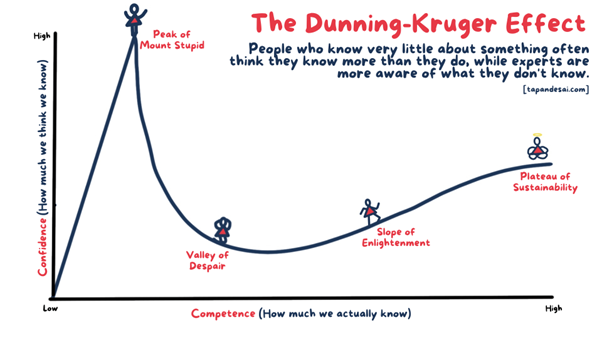
Imposter Syndrome can tie very neatly into that sharp fall into the Valley of Despair; you realise how little you know, how much there is to learn, how are you ever going to learn it all, this is a mistake, you don’t belong here, you know nothing!! And so it goes on and on and on…. (currently me by the way).
Source: 2 Tapan Desai: https://tapandesai.com/dunning-kruger-effect-theranos/
Earning a spot on a PhD programme is not an easy thing to do. And yet, here you are! Here I am. You’ve made it through the applications, the interviews, and you are where you are because of your base subject knowledge, yes, but more so your determination, your courage, and your absolute unfailing ability to
never give up.
Your supervisor chose you, knowing you didn’t know everything, but because of the potential and the dedication they saw in you. If you knew your supervisor beforehand, there is also the shouldn’t-be-dismissed knowledge you will work together for 3-4 years, and you’re just an awesome human being they won’t mind being stuck with for that long!
So Imposter Syndrome is very likely to hit you, as it has me. The first step might actually be to take one back. Look at where you are right now. What you have already accomplished. And sure, part of it might be good timing – you saw a project at just the right moment. But you are here because you put in the work and you deserve to be!
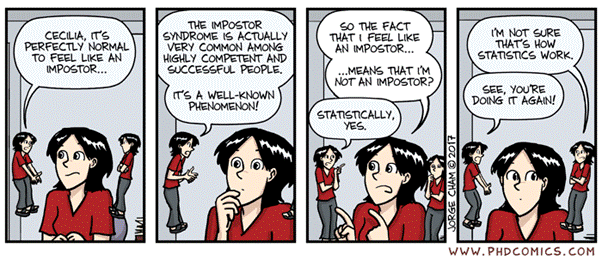
Source: 3 PhD Comics: https://phdcomics.com/comics/archive.php?comicid=1976
Try to keep that thought front and centre, and hopefully I will be writing the ‘Overcoming Imposter Syndrome’ article soon!
Until next time!
References
[1] The Savvy Scientist, ‘Feeling Like a Fraud? Let’s Talk About PhD Imposter Syndrome’. Available here
[2] Sverdlik et al, 2020, ‘PhD Imposter Syndrome: Exploring Antecedents, Consequences, and Implications for Doctoral Well-Being’. Available here
[3] Mullangi and Jagsi, 2019, ‘Imposter Syndrome: Treat the Cause, Not the Symptom’. Available here
[4] Kruger and Dunning, 1999, ‘Unskilled and unaware of it: How difficulties in recognizing one's own incompetence lead to inflated self-assessments’. Available here
