

First few weeks - what to expect
Hi everyone, it’s me!
It’s hard to believe that the first 8 weeks of being a PhD student have now passed. I still find it absolutely insane to tell people that my job is to be a PhD researcher, and I don’t think that will change over the next 3 and a half years.
To say I’m ‘starting to settle’ would be… a lie.
But I wanted to take a few moments to think back on these first few weeks, take stock, and think about the main points I want to share with you, as (hopefully) a prospective PhD student, to offer some insight into the first experiences of this crazy exciting time in your life.

PhD Studentships
First off, let me just point out that some of these points may be specific to my particular circumstances as a recipient of a funded PhD Studentship - my PhD is funded by NERC - the Natural Environment Research Council in the UK, in collaboration with the TREES DLA - Training, Research & Equity in Environmental Sciences, Doctoral Landscape Award.
I am of course incredibly lucky to have this, and would not be able to study without it.
But these points should still be useful to any PhD programme at an academic research institution, whether funded, self-funded, full, or part-time.
Meet with your supervisors…
You may already have a pretty solid relationship with your supervisor, especially if you submitted a research proposal to them, or applied for a specific project they advertised.
But be prepared to, and I highly recommend, meet with your supervisor (and co-supervisor/s) before the start of term.
This can be super useful to help calm any nerves - particularly if you have been away from academia for a little while, reassess the building blocks and starting points for your projects, and if you haven’t had much contact previously, start to build this important relationship.
…and advisor
Y institution may recommend obtaining a project advisor (within about 3 weeks of your official start date - for RHUL) . This will be somebody completely independent from your supervisory team, who will support you throughout your research, crucially in relation to your wellbeing, although it’s always worth looking into a dedicated Wellbeing Team at your institution. Your advisor will also be your port of call if the unfortunate scenario should arise where the supervisor/student relationship gets a bit fraught or even on the edge of breaking down. Having someone independent to talk things through will be a huge help, and avoid any issues you may encounter from spiralling.
Enrolment & Induction
Something you’ve likely done multiple times before - university enrolment. Expect much of the same as your undergrad and Master’s if you did one.
Attend your course and/or department induction if you can - this may even be mandatory. Yes, we all know some of the info is important but dull, but it has to be done. Buy beyond this, inductions will be a great way to introduce yourself to the rest of the team.
For me personally, not only did I meet with the entire Biological Science Postgrad department, including Master’s by Research students, this was time to spend with the new Master’s students in the specific lab.

Forms, forms, forms…
…gotta fill in all those forms (think Bills, bills, bills - if you don’t understand that reference please leave (please don’t actually! But do go and find the song)).
During said inductions, we were introduced to the Eisenhower Matrix (or the ‘Urgent-Important Matrix). These forms place highly on my ‘Urgent but Not Important’ task axis.
There are quite a few of them, for instance; Postgrad Start of Session, BACS, Student ID, campus Parking Permit, Health & Safety, anything and everything related to your Funding, even down to more personal circumstance forms like Student Discount on Council Tax (this one was a very pleasant surprise, but have I heard from the council?? Of course not!).
Just… forms. They will be there. Expect them.
Meet your colleagues
Linked to the above, there may well be a lot of meet and greets, with members from the same lab, same department, same building and larger and larger iterations.
I am not the most sociable of beans - I’m an introvert, I like my space. Networking scares me. But take advantage of as many of these as you can. Be prepared to join a thousand WhatsApp groups (mute them, yes, but you’re in there). Even within my first few days on campus, I felt lonely. Some of these people will be your biggest support for the coming years, take advantage of them.
Explore your campus…
Seems a little obvious, yes. If you’re continuing at the same institution, clearly not needed. For me, I was completely new to the campus - I had visited before and had a brief tour with my now-supervisor, but it was quite hard to take everything in when you’re trying to impress one of the people who could hold your future in their hands!
On my first few days on campus, pretending to look more comfortable than I felt, I wandered my new home to try and get my bearings.
The little wins, such as just knowing where you are going, can make a huge difference.
… and find your space
I was pleasantly surprised to find that my institution had a PhD student ‘office’ and I was entitled to a desk space. Quite clearly, I am still struggling with the fact this is my place of work!
Find yours early.
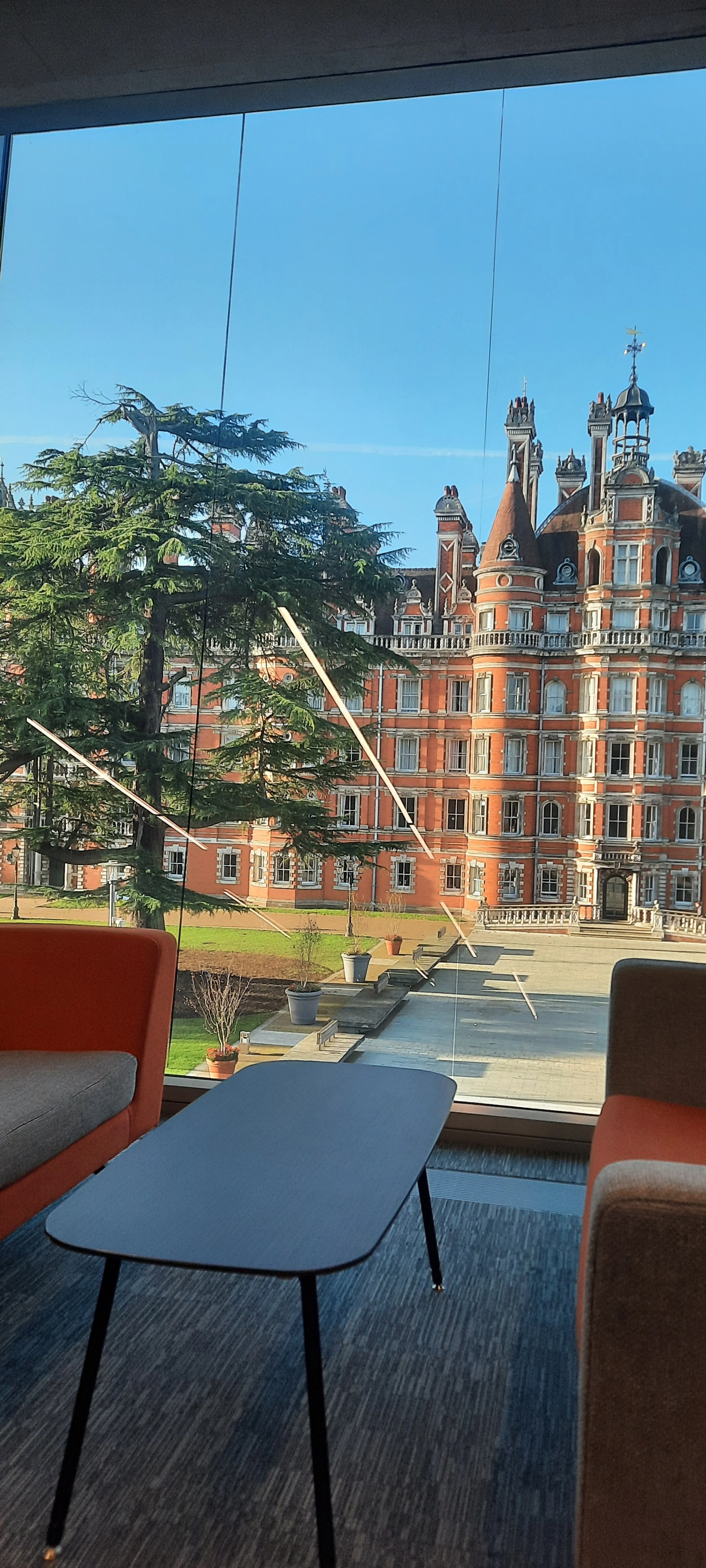
And related to the above, find a place you like to be, and where you like to work. I recently found a rather beautiful spot in the library with a great view out to the Founder’s Building at RHUL - I’ve yet to have to fight someone for it, but as a public space this is far more likely to be taken than my desk in the office. But here is a spot I know I will come when the office walls start to close in.
Training
This point is pretty specific to my experience on a particular scheme run by a particular research council. So I won’t mention much here. If you are are on a Studentship, you will likely know if you have any mandatory training, and team-building, with your cohort.
If not, there may still be some mandatory or recommended training your uni or department wants you to focus on right off the bat. But this point is likely to be very specific to you as an individual.

Start reading
This personally, I am struggling with. I am involved in the above mentioned training, which currently is taking up about 45% of my week. With another day or so set aside for meetings, plus family life, my ‘PhD days’, and within those my Reading hours, are actually far more limited than I would like.
But wherever you can, even if you are continuing the line of research from your Master’s, start reading the academic literature.
I’ve had this mentioned to me SO many times in the first few weeks, and I’m going to do the same. If you’re not already, start using Bibliographic software to manage your references.
I use Zotero, but there are plenty of others out there, and your institution may have their own subscriptions.
Start writing your Literature Review
Finally, I can only speak for my own experience in the Sciences - as far as I understand, a project in the Arts and Humanities may be slightly different. But once you’ve started your Reading, which you should be doing early on, please please please start writing your Literature Review.
Your PhD will not just be turning in your thesis. You may even have to submit a decent chunk of work for your first review - for me this is at 4 months.
This version most likely won’t be the Literature Review you ultimately include, but chances are it won’t be too far off. Start writing early, to get back into the habit of writing, to gain a deeper feel for your project, and so you don’t end up writing everything in your final ‘Writing Up’ year.
This one, I highly recommend!

And that’s it. Congratulations on smashing your first few weeks if you are just starting out.
If you haven’t started yet, I hope this helps give a rough idea of what your first few weeks might indeed look like.
Lauren
P.S. Let’s be friends!
I would love to hear from you; drop me an email. Have suggestions and feedback? Something cool you want me to read? Or just want to say hello? Please do!
